Atomics vs Mutex in Rust: Why Mutex Won Under Heavy Contention
Why a mutex beat atomics under heavy contention — with flamegraphs and a counterintuitive takeaway.
What if I told you a mutex beat atomics in a tight shared-counter benchmark?
That happened in my Rust experiment when I compared:
AtomicU64::fetch_addMutex<u64>
At low thread counts, atomics were clearly faster. At high contention, mutex pulled ahead.
The Benchmark Setup
I benchmarked a single shared counter with Criterion:
- Threads: 2, 4, 8
- Increments per thread: 200,000 and 1,000,000 (plus extra 5,000,000 checks)
- Workload: each thread repeatedly increments the same shared counter
The code is intentionally simple and contention-heavy.
The Performance Data
Here are the main results (Criterion midpoint):
| Increments/thread | Threads | Atomic | Mutex | Winner |
|---|---|---|---|---|
| 200,000 | 2 | 1.44 ms | 7.15 ms | Atomic (~4.98x) |
| 200,000 | 4 | 6.40 ms | 11.65 ms | Atomic (~1.82x) |
| 200,000 | 8 | 25.75 ms | 19.18 ms | Mutex (~1.34x) |
| 1,000,000 | 2 | 7.63 ms | 45.83 ms | Atomic (~6.00x) |
| 1,000,000 | 4 | 35.21 ms | 60.59 ms | Atomic (~1.72x) |
| 1,000,000 | 8 | 133.23 ms | 97.88 ms | Mutex (~1.36x) |
I also reran only 2-thread cases with larger input sizes:
- 200k/thread: atomic ~10.7x faster
- 1M/thread: atomic ~6.2x faster
- 5M/thread: atomic ~3.5x faster
So lower contention strongly favors atomic.
The Counterintuitive Part
If atomics are “lighter” than mutexes, why does mutex win at 8 threads here?
Because this benchmark is not measuring lock overhead in isolation.
It is measuring contention on one shared cache line.
What Actually Happens in the CPU
Atomic path (fetch_add)
Even if your code only updates and never explicitly reads, fetch_add is still a hardware read-modify-write operation.
That means the core needs exclusive ownership of the cache line before updating.
With many threads on one shared counter:
- cache-line ownership keeps moving between cores
- coherence traffic increases sharply
- the atomic instruction becomes the bottleneck
This is cache-line ping-pong (line handoff).
Mutex path
Mutex still contends, but lock arbitration changes behavior:
- threads do not all hammer the same line at full speed simultaneously
- some contenders spin/park/wake
- coherence pressure can be lower than naive atomic hot-loop contention
So under very high contention, mutex can be less bad than a single shared atomic increment loop.
Profiling Evidence
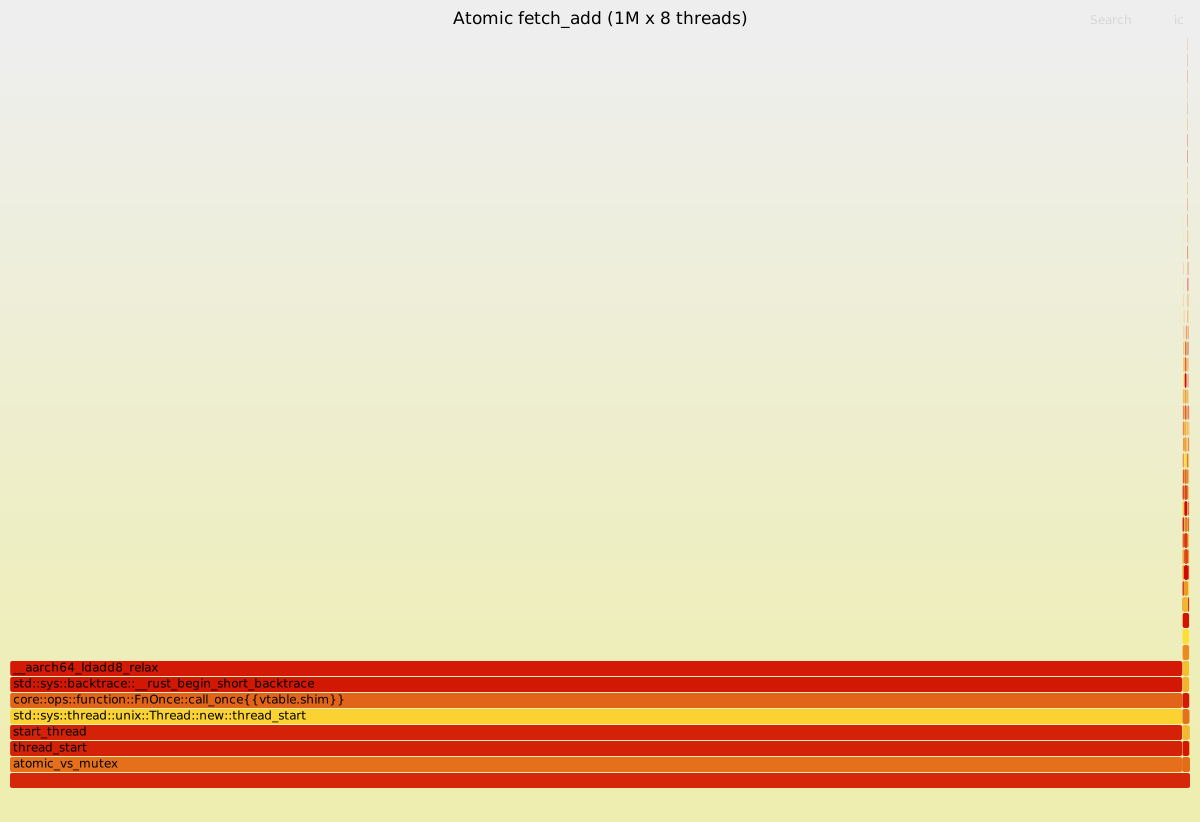
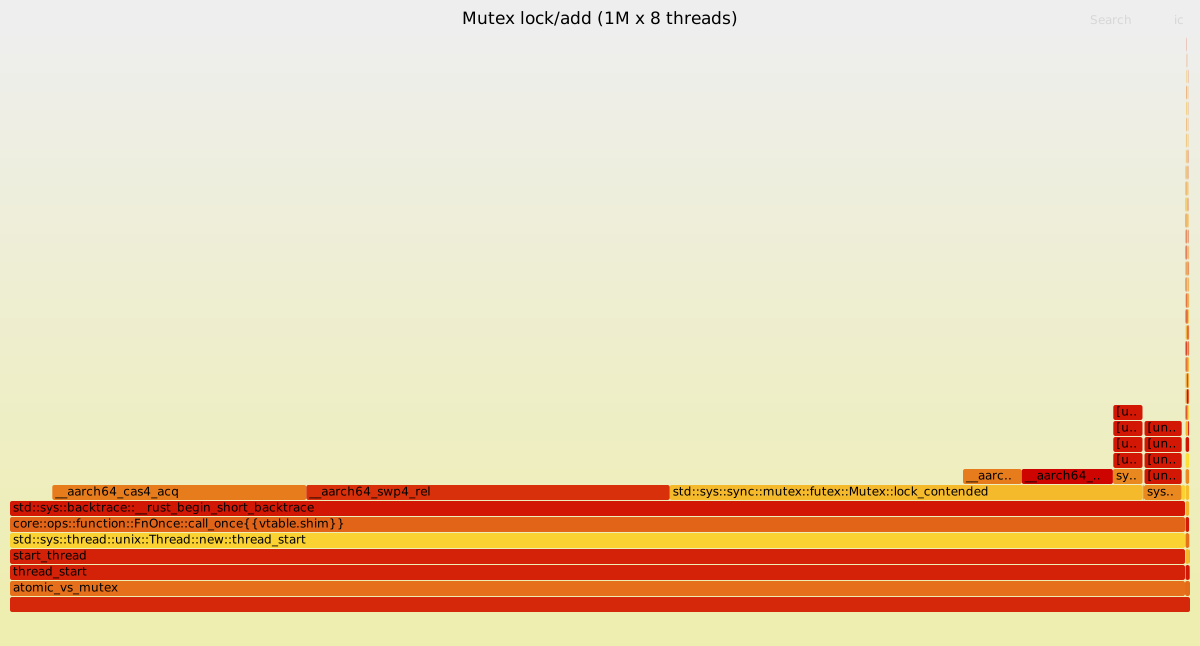
I profiled the 1M x 8 threads case with Linux perf and flamegraphs.
Atomic flamegraph
The hotspot was dominated by:
__aarch64_ldadd8_relax
That is the atomic RMW instruction itself, matching the “contended atomic” hypothesis.
Mutex flamegraph
Time was spread across lock paths:
Mutex::lock_contended- CAS/SWAP primitives
- futex/syscall paths
So atomic cost was concentrated in one heavily contended instruction; mutex cost was distributed across lock arbitration.
Difference: Atomics vs Mutex Lock
Both are synchronization tools, but they solve different problems.
| Aspect | Atomics | Mutex Lock |
|---|---|---|
| Scope | Single value / primitive operations | Critical section over one or more shared values |
| Blocking behavior | No lock acquisition API; operation executes atomically | Can block/wait when lock is contended (spin/park/wake) |
| Low-contention cost | Usually lower overhead | Usually higher overhead per operation |
| High-contention behavior | Can bottleneck badly on one hot location (cache-line ping-pong) | Can sometimes outperform naive atomics by arbitration/serialization |
| Correctness model | Harder for multi-step state transitions | Easier for compound shared-state updates |
| Typical use | Counters, flags, state bits, lock-free primitives | Multi-step shared data mutations requiring mutual exclusion |
| Rule of thumb | Use for simple independent state changes | Use when correctness needs compound updates |
Practical Takeaways
- Atomics are not automatically faster under all contention levels.
- A single global atomic counter can scale poorly with many writers.
- Mutex can outperform naive atomics in highly contended single-counter patterns.
- The best optimization is often reducing contention, not changing one primitive to another.
Better Designs for Production
If your workload looks like this benchmark, these patterns usually help more:
- per-thread local counters + final reduce
- sharded atomics (N counters) + sum
- batched updates (local accumulation, occasional global flush)
- avoid one global hot counter on critical paths
Run It Yourself
Code is available here:
🔗 github.com/RatulDawar/rust-experiments
The benchmark crate used here is atomics-vs-mutex.
The Bottom Line
The real question is not just:
atomics vs mutex?
The real question is:
how much shared cache-line contention does this design create?
Under low contention, atomics shine.
Under heavy contention on one shared location, mutex can win.